Motion · 3 min read
Average Speed: the method, worked through
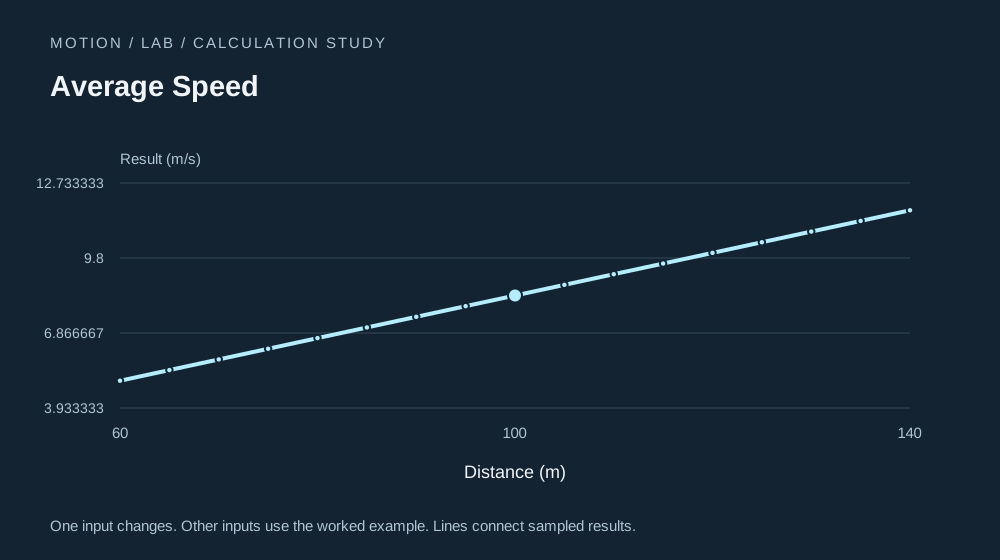
Average speed summarizes a complete journey using total path length and elapsed time.
A laboratory notebook for classical mechanics, waves and thermal quantities. Ideal models, explicit units, useful answers.
Motion · 2 inputs
Average speed summarizes a complete journey using total path length and elapsed time.
Open calculator ↗Constant-speed travel produces a distance proportional to elapsed time.
Open calculator ↗Dividing a path length by steady speed estimates the time needed to cover it.
Open calculator ↗Acceleration measures how velocity changes over time and can be signed in one dimension.
Open calculator ↗Uniform acceleration changes velocity by a fixed amount each second.
Open calculator ↗The displacement combines the initial-velocity contribution with the effect of constant acceleration.
Open calculator ↗An object released from rest accelerates downward under a uniform gravitational field.
Open calculator ↗Conservation of energy relates a drop from rest to the ideal final speed.
Open calculator ↗The ideal horizontal range depends on launch speed and elevation angle when landing height equals launch height.
Open calculator ↗Only the vertical component of launch velocity determines height above the launch point in an ideal trajectory.
Open calculator ↗A symmetric ideal trajectory spends equal time rising and falling to its original elevation.
Open calculator ↗Newton's second law connects net force to acceleration for constant mass.
Open calculator ↗Weight is a force caused by gravity and varies with gravitational field strength.
Open calculator ↗Linear momentum combines mass with signed velocity in one dimension.
Open calculator ↗Impulse accumulates force over time and equals the change in momentum.
Open calculator ↗Hooke's law relates small elastic deformation to restoring force magnitude.
Open calculator ↗A simple dry-friction model estimates sliding resistance from normal force and a friction coefficient.
Open calculator ↗Torque depends on the force component perpendicular to the lever arm.
Open calculator ↗Circular motion requires inward acceleration even at constant speed.
Open calculator ↗The net radial force needed for circular motion grows with the square of speed.
Open calculator ↗Translational kinetic energy is the energy associated with motion of a mass.
Open calculator ↗Near a planetary surface, a change in height changes gravitational potential energy approximately linearly.
Open calculator ↗An ideal linear spring stores elastic energy as it stretches or compresses.
Open calculator ↗Work depends on the component of a constant force along the displacement.
Open calculator ↗Power describes the rate of transferring energy or doing work.
Open calculator ↗Efficiency compares useful output with the total energy supplied to a defined system.
Open calculator ↗Density connects how much mass occupies a measured volume.
Open calculator ↗Average pressure spreads a normal force over its contact area.
Open calculator ↗Fluid pressure rises with depth under uniform density and gravity.
Open calculator ↗Buoyancy equals the weight of displaced fluid in the elementary hydrostatic model.
Open calculator ↗Volumetric flow connects average speed through a section with that section's area.
Open calculator ↗Mass flow converts a volume flow using the density at the measurement conditions.
Open calculator ↗A wave travels one wavelength during one cycle, linking frequency, wavelength and propagation speed.
Open calculator ↗Frequency is the number of cycles passing a point per second.
Open calculator ↗The period is the duration of a single repeating cycle.
Open calculator ↗A simple pendulum's small-angle period depends primarily on length and gravity.
Open calculator ↗An ideal mass-spring oscillator has a period set by inertia and restoring stiffness.
Open calculator ↗Angular speed converts complete turns per minute into radians per second.
Open calculator ↗Points farther from a rotation axis move faster at the same angular speed.
Open calculator ↗A uniform solid disk resists angular acceleration according to its mass distribution about the central axis.
Open calculator ↗Rotational energy depends on angular speed and how mass is distributed around the axis.
Open calculator ↗For rotation about a fixed principal axis, angular momentum is inertia times angular velocity.
Open calculator ↗Sensible heat changes temperature without changing phase.
Open calculator ↗Latent heat estimates energy involved in a phase change at the appropriate transition condition.
Open calculator ↗A linear expansion model estimates a small length change from temperature difference.
Open calculator ↗The ideal gas law relates pressure, amount, temperature and volume.
Open calculator ↗The Kelvin and Celsius scales have equal interval sizes but different zero points.
Open calculator ↗This affine conversion changes both interval size and reference zero.
Open calculator ↗Kilometres and hours convert independently into metres and seconds.
Open calculator ↗A kilowatt-hour combines a power level with a duration to measure energy.
Open calculator ↗No matching tools. Try a shorter search or choose all categories.
Average speed summarizes a complete journey using total path length and elapsed time.
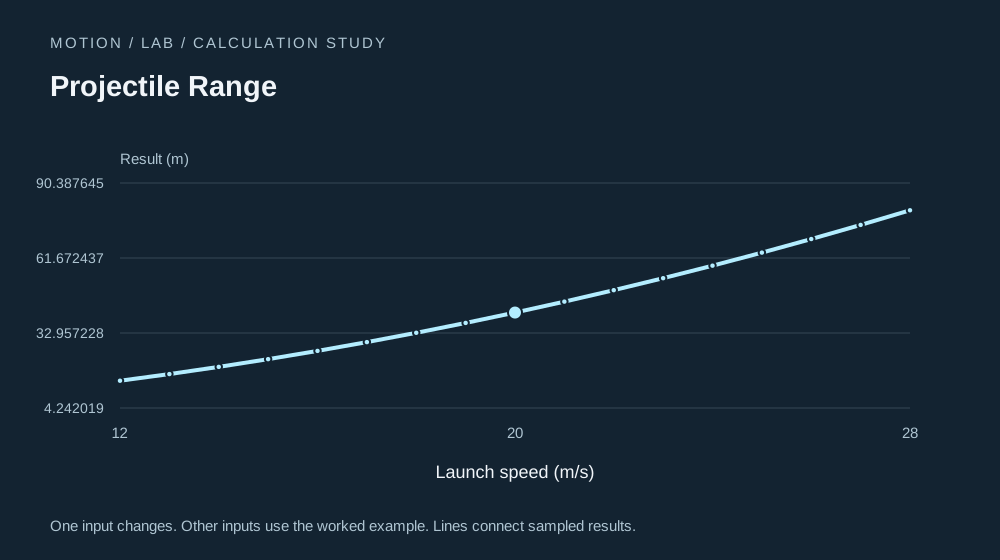
The ideal horizontal range depends on launch speed and elevation angle when landing height equals launch height.
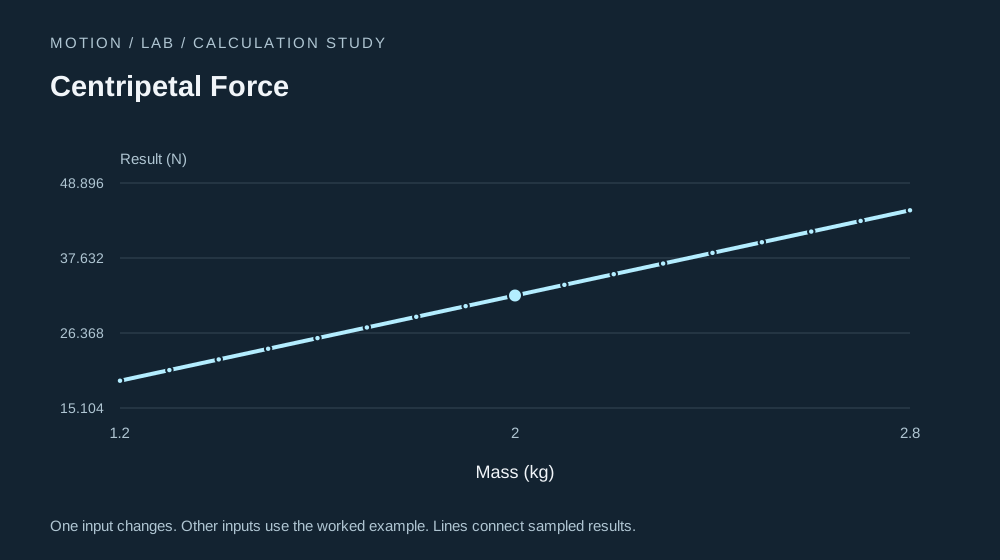
The net radial force needed for circular motion grows with the square of speed.